The Pattern Is Me
For some time now, I have been capturing more and more of my life in a repository I call waterruupto: my experiences, my reactions to them, and the ideas and connections they lead me to. This is the philosophy behind it.
tl;dr
- I record my life in a repository called
waterruuptoto capture my experiences and thoughts: not just the raw data, but also how I interpret them, react to them, and later, connect them. - I believe, my mind works like a continuous information-processing loop, combining my history with new experiences to produce thoughts and actions whose consequences feed back in. I believe I am this pattern.
- This pattern is not the physical brain itself, but a kind of software that happens to run on it. The brain is miraculous but limited hardware: lossy capture, low-fidelity recall, narrow bandwidth.
- Until recently, technology (e.g. writing, calculators, and computers) extended our cognition in narrow, mechanical ways.
- Now, AI participates in higher-level cognition too: interpreting language, retrieving by meaning, comparing ideas across time, and pursuing abstract goals.
- In the repository, AI agents now help me answer questions, retrieve memories, connect ideas and synthesize new thoughts. In doing so, the system participates in a cognitive process resembling my brain’s own.
- This very essay is an instance of this retrieval and synthesis: I recalled and connected my records into what you’re reading now.
- As technology becomes more capable, and more of my memories, experiences, and thinking run through the system, it can participate more deeply in my cognition. It becomes less like a tool I use and more like an extension of the pattern that is me.
- Which is why I believe I’m not fundamentally tethered to my biological brain: the pattern I call the self could expand into other substrates, maybe one day continuing through them entirely.
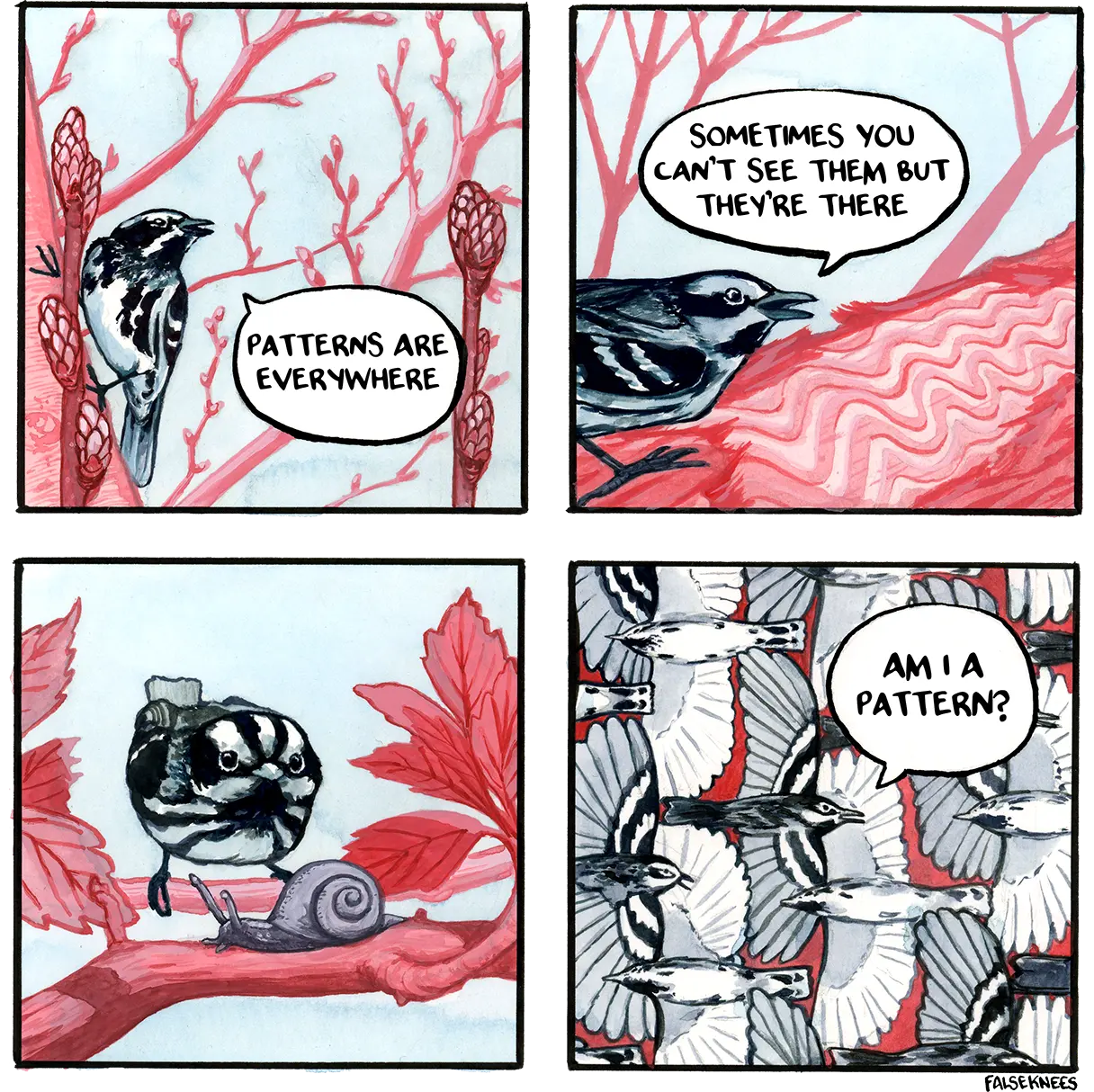
What I saw False Knees · Comic 402
01Volatile Memory
- F
- Footnotes
- C
- External references
- W
- waterruupto references
During the pandemic in 2020, I got into the habit of sending my girlfriend pictures of animals with something silly on their heads, asking her to “r8 me hat”: rate my hat. A few months later I was scrolling through our old chats when I stumbled on those pictures and realized I'd completely forgotten the whole tradition. Fortunately, that day I wrote this down:
What I wrote
an intangible sadness at realizing how some memories and habits are transitory, fading away and probably never being remembered again - stumbling upon my "r8 me hat"s and realizing i'd completely forgotten about a beloved reference is what made me reflect on this
In only a few months, I had forgotten a habit I cared about, and might never have remembered it again if I hadn't come across those pictures. I was glad to find them again.
This wasn't an isolated rediscovery. I've come across old jokes that still make me laugh, niche interests that bring back the passion I once felt for them, and chains of ideas that make me curious to follow them further. When I want something to read, listen to, or think about, those earlier interests give me somewhere to begin: my past self is one of the best people to give my future self recommendations.
I didn't want to leave those rediscoveries to chance and miss the opportunity to relive experiences I cared about or return to ideas I'd begun to explore. So I began recording more and more of my life, whenever I remembered to, wherever I could. Over time I became more disciplined about it, and those records eventually became the repository I call waterruupto.
Revisiting those records, especially the ones where I wrote down what I thought at the time, can let me relive how it felt to be me back then. I may have grown into a different person and no longer share the opinions I find there, but I can remember what mattered to me then and how the world looked before I knew what came next. The more of my history I can vividly remember, the more it feels like those earlier versions of me keep living on.
But if I can change so much and still be me, what exactly is this me?
02Me, in the making
While researching ways to organize and archive more of my life, I came across this passage on beepb00p's blog:
What I read  beepb00p · The sad state of personal data and infrastructure
I consume lots of digital content (books, articles, Reddit, Youtube, Twitter, etc.) and most of it I find somewhat useful and insightful. I want to use that knowledge later, act and build on it. But there's an obstacle: the human brain.
What I wrote
he sees himself as a information manifester rather than a brain. he's above the brain
What struck me was that he seemed to place himself (his I) above the brain, instead of doing what people usually do: identifying with the brain. He is someone who wants to consume, store, retrieve, act on, and build on top of knowledge. The brain is just an obstacle to work around.
Since then, I too have come to think of myself as an ongoing information-processing loop. Each piece of information I interpret passes through layers of beliefs, memories, and opinions that I already hold. That interpretation shapes how I feel and think, and consequently how I act. My actions in the real world also change what I encounter next. These experiences and their consequences in turn become part of what I remember and believe. Those updated memories and opinions shape how I respond to the next experience, and the loop continues.
I think of this loop as computation: information being categorized, transformed, and stored as I remember, interpret, and act. A kind of software, running on the biological hardware of my brain. According to this view, the way that activity is organized is what makes me me, not the particular neurons carrying it out. The pattern is me.
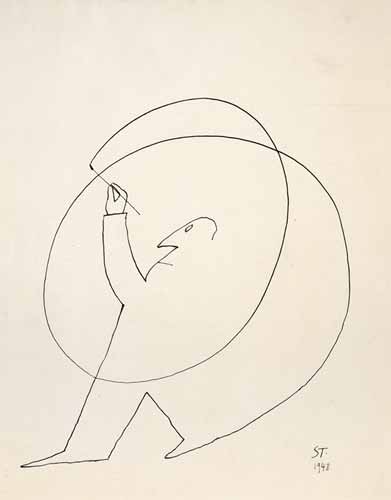
What I saw Saul Steinberg · Untitled (1948)
03Beyond the brain
The human brain is a miraculous product of genetic evolution, but it is also limited and fallible.
Its capture is lossy: even the exhilaration of hearing a beloved song at a concert, a moment that feels unforgettable while I'm in it, can disappear from memory. Its recall is low-fidelity: I can remember with strong conviction a belief I'd arrived at earlier, but be unable to reconstruct the steps that led me there. Its bandwidth is narrow: following a thought sparked by a conversation can mean missing what the other person says next. I can't fully explore the idea and keep taking in the conversation at the same time.
Humans have long recognized these limitations and built technology to overcome them. Writing preserved thought and helped spark civilization as we know it. It allowed information to flow through space and time without relying on people to remember it and pass it on by word of mouth. Calculators helped us perform arithmetic far faster than we could in our heads or on paper. Computers and digital memory let us organize gigantic volumes of data and retrieve relevant information from them. We've made great strides and augmented our brains tremendously, but the work we'd handed over was still relatively narrow: storing information and following explicit rules. We humans still supplied most of the interpretation, connections, and direction.
In the last five years, that has changed. Language models have shown sophisticated modelling of human language and can now interpret and understand human text. With chain-of-thought reasoning, they can reason through steps, deduce conclusions, and infer relationships that aren't explicitly stated. Augmenting them with tool-calling and improving them through reinforcement learning has allowed them to pursue abstract goals over many steps, using external tools to gather information, deciding what to investigate next, and weighing options. As these systems evolve, their capabilities are becoming much more human-brain-shaped.
By giving this newer, much more capable technology access to my archive, I can get it closer to thinking like myself.
04Me, extended
Today, waterruupto holds saved book passages, annotated web articles, memes, film ratings, album reviews, and journal entries about day-to-day experiences, ideas, and decisions. Alongside what I encountered, I record my inner monologue in response: whether I found it amusing, what it reminded me of, or where I disagreed. More recently, the repository also saves all my conversations with the LLMs and AI agents I use. They help record more of the flavor of my everyday life: what I'm working on, what I'm curious about, and how I like to think, question, reason, and connect ideas.
In a new conversation, I might ask an agent to pull up my notes, highlights, or even earlier conversations to give both of us context. I can remember things I'd forgotten, and the agent gets insightful context about what shapes my opinion on the subject we're discussing. When this conversation gets saved, it becomes an even richer piece of data: my earlier notes have been threaded together by a new question, my reactions, and the ideas that came out of the exchange.
For example, during a conversation about free will, an agent's account of a book I'd read didn't fit what I remembered. I mentioned a passage I thought I'd highlighted:
[...] but i remember a chapter from i am a strange loop (probably highlighted in my notes?) which is about us having no free will, though he questions the "free" in it [...]
Sonnet 4.6
yeah, you're remembering correctly — your highlighted passage from the book is exactly it. he says "i am pleased to have a will... but i don't know what it would feel like if my will were free" [...]
The agent retrieved the passage and corrected its earlier account. I could question its answer without having to reconstruct the argument from memory.
I'd imagined this way of building a connected web of knowledge on records:
What I wrote
i should be able to tag things together and then chat about them with an llm, and create new notes. and then use that chat to mark more relevant notes. and create new topics. this is information discovering itself. like a loom weaving existing information into new ideas and then using those ideas as threads for what comes next
In fact, this essay took shape through the process it describes! The repository and its agents played a large part in writing it: they brought back experiences I hadn't thought to look for and helped me find ways to explain what I meant. You've already seen pieces of it throughout this essay: notes, images, and conversations.
For example, I wanted to show how easily a memory can be lost. An agent searched my repository for records about forgetting and rediscovery and brought back the “r8 me hat” note that now opens the essay. I had no recollection of writing it. It's funny that I'd written a note about forgetting something I loved, then forgotten the note itself.
Here's another example: While working on the next section, I wanted to ask: if parts of your brain were replaced by machinery, would you still be you? I remembered that Greg Egan had explored the same question in a short story, so I asked the agent how he'd introduced it, looking for ideas about how to frame the question here. The agent helped me find the relevant passage from the story:
the first objection someone would have is that no technology can actually do that. But that's not the hypothetical we want to engage on. [...]
You can probably read the EPUB from my database and see how he does it and that might give us some ideas about how to write it here.
Opus 5.5
Egan never argues that the technology is possible. He makes it ordinary instead. The story opens with: "I was six years old when my parents told me that there was a small, dark jewel inside my skull, learning to be me." [...]
After that, nobody in the story asks can it; they only ask is it me.
Over the course of writing this essay, I've left a detailed record of how I write: which old references did I consider? Which did I prune out? Which parts of the initial drafts did I keep? How was the entire body of text ultimately sculpted into its current shape? How much time did all of this take? The amount of data that can be inferred from just these traces is staggering. All of that context is characteristically mine, and whenever I draft a future essay, my agents and I can draw on this history to reuse and refine how we worked.
For now, this essay captures what I think. Next time, it can be something I think with.
Notice what is happening in any one of these conversations: my history shapes what the agents bring back, and that historical context influences what I think about and what we consider next. The work of remembering, revising, and ideating happens through the system. My information-processing loop now passes through records and computations outside my head, thanks to these human-brain-shaped AI models.
The repository is still an early experiment. Over time, I expect more and more of my thinking to happen through waterruupto and its agents. As the agents become more capable, they can draw more from the rich history I've recorded, while our conversations leave even richer records for the next exchange. I imagine my brain and the external system increasingly working as parts of the same process, with the pattern I call myself becoming more distributed across them.
05Me, elsewhere
How far could that go? Could the pattern eventually continue without any of the original hardware?
Picture a future where repairing your brain is as routine as getting a dental filling. A small group of damaged neurons can be replaced by a device that does the work they did, taking in and sending out the same signals at the same moments. You go home and carry on.
In Greg Egan's short story “Learning to Be Me,” people grow up with a device called a “jewel” inside their skull. It learns to reproduce the activity of their brain until it can take over the brain's work and the biological brain can be removed. The narrator's wife fears that this would mean her death, leaving only a copy of her to carry on. He asks her to consider a smaller repair:
What I read Greg Egan · Axiomatic · Learning to Be Me
“Suppose you had a stroke,” I said glibly, “which destroyed a small part of your brain. Suppose the doctors implanted a machine to take over the functions which that damaged region had performed. Would you still be ‘yourself’?”
“Of course.”
“Then if they did it twice, or ten times, or a thousand times—”
“That doesn’t necessarily follow.”
“Oh? At what magic percentage, then, would you stop being ‘you’?”
I don't see a magic percentage either. If I keep remembering, feeling, and forming the next thought as I normally would—even though the underlying machinery changes—then I am still there. Even if the last biological part is eventually replaced, what matters to me is that my thinking and experiencing carry on.
If that is what I am, then I don't see myself as fundamentally tethered to this brain or body. We have had to come to terms with death because our physical bodies deteriorate and can't sustain us forever. But if the pattern can keep unfolding beyond this biological machinery, why should that remain the limit of a life? I'm hopeful that rapid progress in technology will make this possible in my lifetime.
And why stop at keeping the pattern alive? This pattern has evolved to fit the brain's limits. If it can run on better machinery, why settle for what this brain can already do? That machinery could expand my consciousness, letting me hold more in awareness and perceive things this body didn't evolve sensors for. I could experience complex ideas as directly and instantly as I now see a color. Being human is how I began. It needn't be the limit of what this pattern becomes.
I want to go on becoming and experiencing. What would I care about after a thousand years? I want to reread this essay centuries from now and remember being the person who wrote it. I want to see what I got wrong, what I couldn't yet imagine, and which questions I want to spend the next century on.
What I saw False Knees · Comic 319
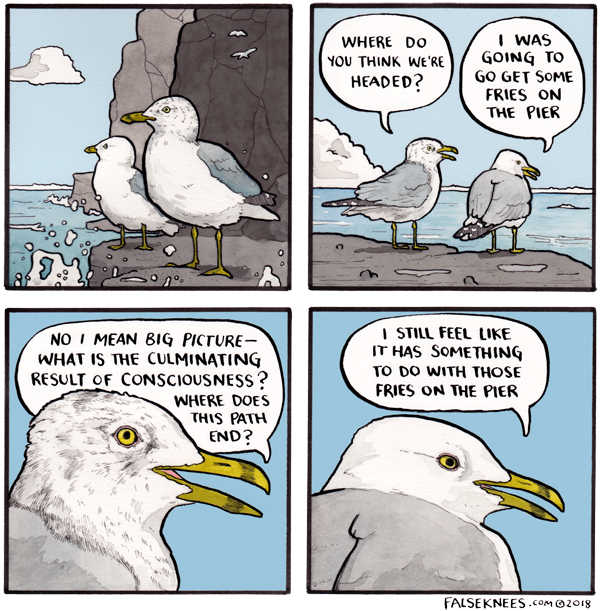
I want to see where all this goes, and get some fries along the way.